

The company that has "done AI" for two years and has nothing to show for it
Every industry now has this company. It bought the licenses. It ran the workshop. Someone on the leadership team can talk fluently about agents and copilots. And somewhere in a shared drive there's a folder of proof-of-concept demos that never became anything a customer, employee, or balance sheet would notice.
This isn't a failure of ambition or of the technology. Generative and agentic AI genuinely can do what the demos promise. It's a failure of sequence. Most organizations try to do the third step — build something — before they've done the first two: build real organizational understanding of what AI can and can't do, and decide, with evidence, where it actually pays back. Skip straight to building, and you get exactly what most companies have: technically impressive tools nobody fully trusts, uses, or can justify the cost of.
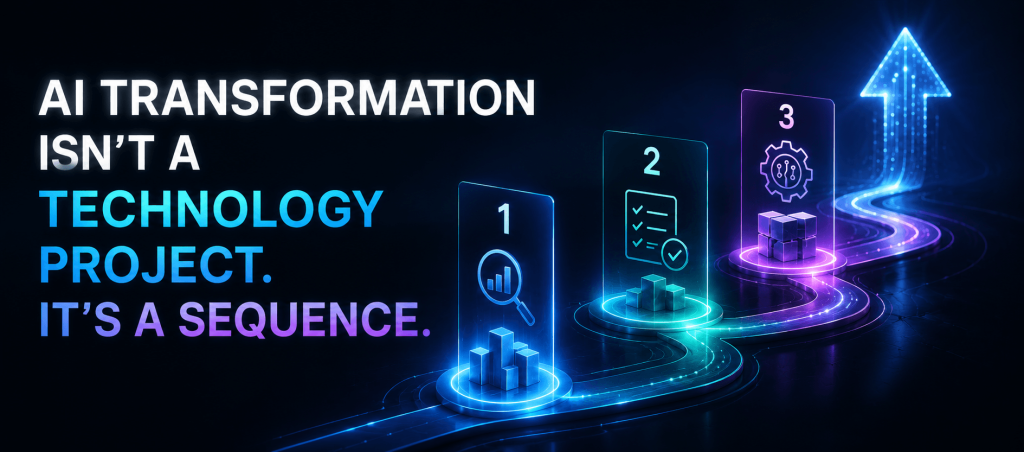
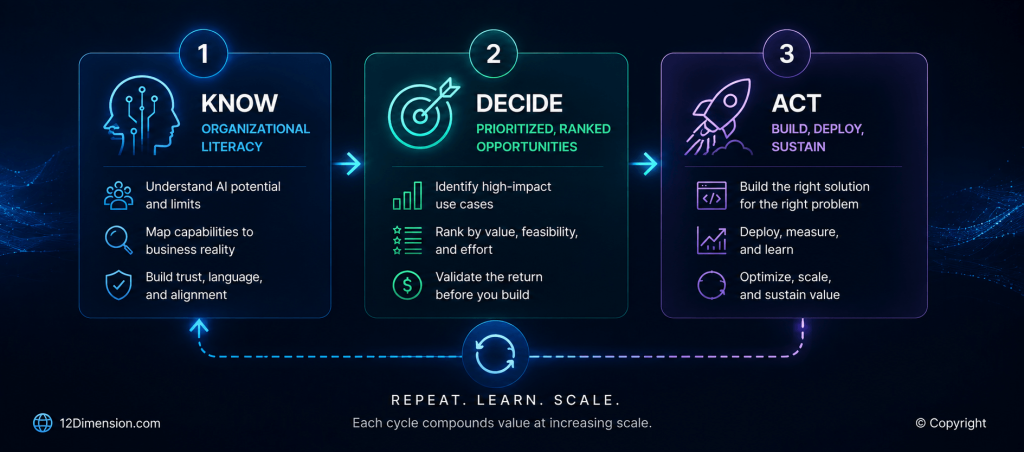
The alternative isn't more caution. It's a different order of operations: Know, then Decide, then Act. It sounds almost too simple to be a methodology. In practice, it's the difference between AI transformation that compounds and AI transformation that quietly stalls.
Why this sequence matters more for some companies than others — and why it applies to all of them
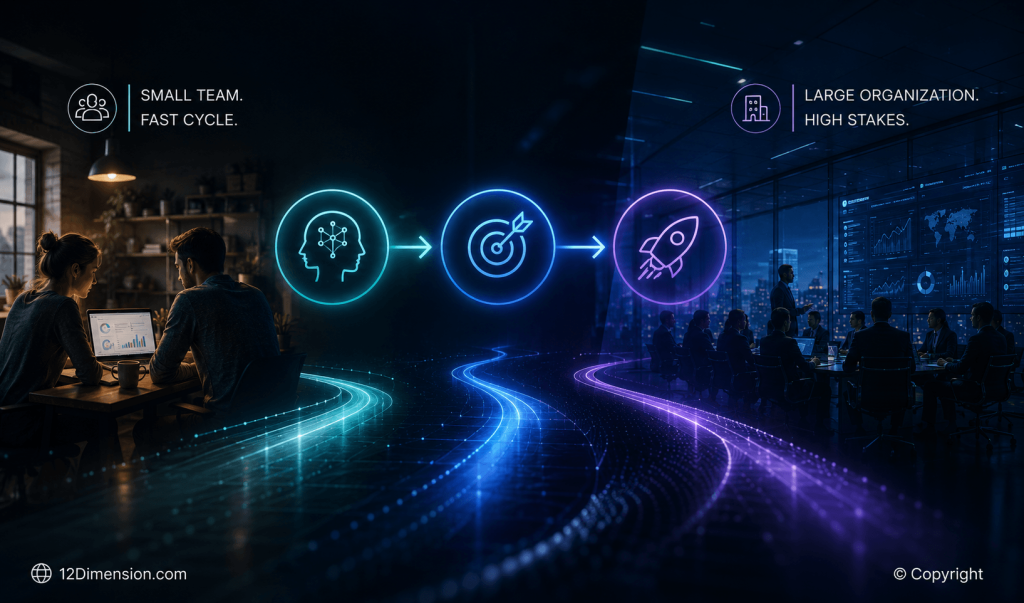
Scale changes what each stage looks like, but it doesn't change whether you need all three.
A twelve-person e-commerce business doesn't need a five-department rollout plan. It needs one person who understands what's actually possible, one clear-eyed look at where the time or money is really being lost, and one well-scoped build that solves it. The stages compress into weeks, not quarters.
A multinational manufacturer or financial institution needs the same three stages, but each one now has to survive contact with legal, security, twelve business units, and a board that wants a number attached to the word "AI" before it approves anything. The stages don't disappear — they just get heavier, and skipping one gets far more expensive, far faster.
What we've found working across both ends of that spectrum is that the size of the company changes the scope of each stage, not the need for it. A rushed SMB and an under-scoped enterprise program fail for the identical reason: they built before they knew, and they knew before they decided.
Stage one: Know
Before an organization can make a good decision about AI, the people in it need an accurate — not hyped, not fearful — picture of what the technology actually does. This is the stage most companies either skip entirely or outsource to a one-hour webinar that leaves everyone more confused than before.
Real organizational literacy means leadership can distinguish a genuine capability from a vendor's marketing claim, middle managers can spot where AI fits their own function without waiting to be told, and frontline employees have enough hands-on exposure that AI reads as a tool rather than a threat. None of that requires everyone to become a data scientist. It requires everyone to stop operating on rumor.
This is deliberately not a one-size-fits-all session. A leadership team needs a different conversation than a customer service department does, and a department needs a different one than a multi-session upskilling track meant to build lasting fluency. That's the reasoning behind offering these as separate tracks rather than a single generic course — through AI Training, built around whichever altitude the audience actually needs. For organizations that want to open this conversation at the leadership or company-wide level first — a keynote, an executive briefing, a hands-on workshop — Speaking & Workshops is usually the right starting point, and often the fastest way to convert boardroom curiosity into an actual mandate to move to the next stage.
Stage two: Decide
Once an organization has a clear-eyed understanding of what's possible, the temptation is to jump straight to building the first exciting idea that comes up in a meeting. This is where most AI budgets get wasted — not on bad technology, but on the wrong use case, chosen for how impressive it sounds rather than how much it's actually worth.
Deciding well means treating "where should we apply this" as its own discrete piece of work, not a five-minute conversation before a build kicks off. It means scoring opportunities against both business impact and effort, being honest about which ones are genuinely AI problems versus problems with a simpler, cheaper fix, and being willing to say "not yet" to an idea that's popular but not yet ready.
This is exactly the discipline behind CLEAR Discovery — mapping where AI actually creates value across your business or a specific product line, scoring every opportunity honestly, and ending in a ranked, signed recommendation you can act on, rather than a slide of vague possibilities. If the open question is narrower — "we already have an AI tool, is it actually good, secure, and worth what we're paying for it" — Product Audit answers that directly, whether you built the tool or you're about to buy one. And because the right use case today isn't necessarily the right one in twelve months, AI Consultancy & Strategy exists for the ongoing version of this question — ongoing advisory that keeps finding where AI pays back as your business and the technology both keep moving.
Stage three: Act
Only once you know what's real and you've decided where it's worth spending money does building actually make sense — and even here, most six-figure AI projects don't fail on bad code. They fail on a vague brief handed to a vendor whose incentive is to say yes to anything, on a build that quietly balloons past its original scope, or on a proof of concept that was never designed to survive contact with real data and real users.
Acting well means getting the specification right before a single line of code is written — deciding honestly whether to build, buy, or extend an existing tool, with a real cost and timeline attached, not an optimistic guess. It means the people building the thing are accountable to the business outcome it was supposed to produce, not just to shipping something that runs.
That's the purpose of the AI Implementation Blueprint — an independent, vendor-neutral spec that defines what "done" actually means before you hand a large build to anyone, so you're negotiating from a position of knowledge rather than hoping the vendor got it right. When the build itself is the job — a tailor-made solution engineered around your actual data and systems rather than a generic wrapper around a public model — that's Custom AI Development. For research-heavy or data-intensive work that needs academic-grade rigor rather than a quick dashboard, Advanced Analytics & Academic covers that ground. And because a growing company and a large enterprise need very different scales of the same discipline, Practical AI: SMB to Enterprise is built to be right-sized — the same rigor, scaled to what your business can actually absorb and afford.
The mistake underneath most of these mistakes
If there's one pattern underneath all of this, it's that companies treat AI transformation as a single decision — "should we do AI" — instead of a sequence of smaller, honest ones. Knowing is a decision. Deciding is a decision. Building is a decision. Each one deserves its own attention, its own evidence, and its own moment of "are we sure," rather than being folded into a single enthusiastic kickoff meeting.
The companies that get real, compounding value from AI aren't the ones that moved fastest. They're the ones that moved in order — and were disciplined enough to go back to "know" or "decide" when the facts on the ground changed, instead of ploughing ahead on a plan built six months earlier under different assumptions.
Where to start
If you're not sure which of the three stages your organization actually needs right now — genuinely unsure whether the gap is understanding, prioritization, or execution — that diagnosis is itself the starting point, and it's exactly what a structured first conversation is built to surface.