




The failure that never shows up in the post-mortem's first paragraph
When an AI product quietly dies, the founders usually blame something technical: the model wasn't accurate enough, the demo didn't convert, the pilot stalled. Rarely does the post-mortem open with the honest line — we never actually checked if this was needed, by whom, or at what price.
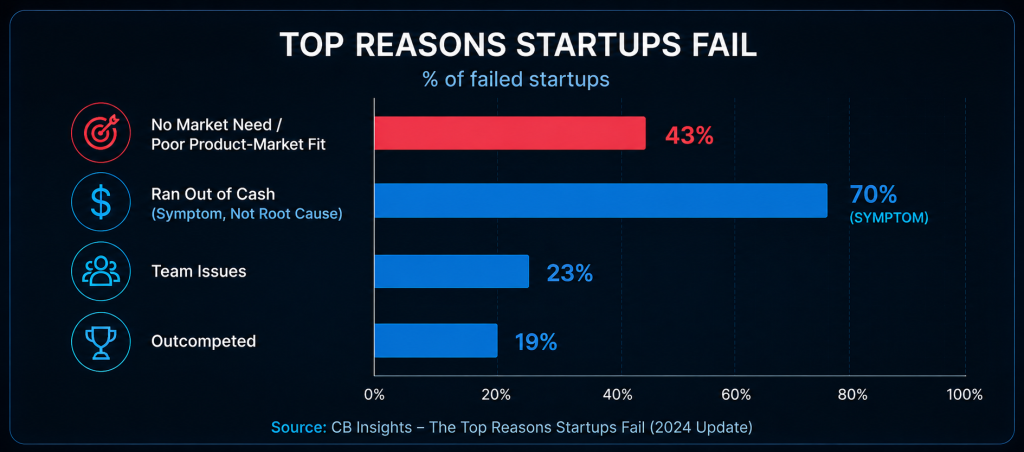
But that's what the data keeps showing. CB Insights' original analysis of failed startups found that 42% cited "no market need" as a primary cause of death — more than any other single factor, including running out of cash. A 2024 update, built on a larger sample of 431 failed venture-backed companies, sharpened the picture further: 43% failed due to poor product-market fit, and while 70% technically "ran out of cash," CB Insights is explicit that this is the symptom, not the root cause — the money runs out because nobody validated demand before spending it.
AI doesn't fix this problem. It hides it better.
There's a comfortable assumption floating around right now: that AI is different, that the technology is moving so fast that the old rules of market validation don't apply. The 2025–2026 data says the opposite.
MIT's Project NANDA reported in mid-2025 that 95% of generative AI pilots at companies delivered no measurable impact on profit and loss — not because the models failed, but because most pilots were never connected to a defined business outcome in the first place. Gartner's own research points the same direction: in a survey of 782 infrastructure and operations leaders run in late 2025, only 28% of AI use cases fully met ROI expectations, while 20% failed outright. Gartner has gone further still, predicting that over 40% of agentic AI projects will be canceled by the end of 2027, citing escalating costs, unclear business value, and weak risk controls — not model quality.
Put simply: it's now easier to build an AI product than to know whether you should. The barrier to shipping something has collapsed. The barrier to shipping something people actually pay for hasn't moved at all.

Why "the market is huge" isn't an answer
Meanwhile, the money is real, and that's exactly what makes this risky. According to Stanford's 2026 AI Index, global corporate AI investment hit $581.7 billion in 2025 — up roughly 130% in a single year — with private investment alone reaching $344.7 billion. Generative AI captured close to half of all private AI funding, growing more than 200% year over year. Capital is not the constraint. Attention, urgency, and a "we can't afford to be left behind" mindset are pushing founders and internal teams to build first and validate later, if at all.
That's precisely backwards. A large, growing market says nothing about whether your specific product solves a problem painful enough for a defined audience to pay for — at a price and through a channel that make the business work. "AI is booming" is not market research. It's the reason market research matters more, not less: everyone else is rushing in with the same shortcut.
What an actual pre-build check answers
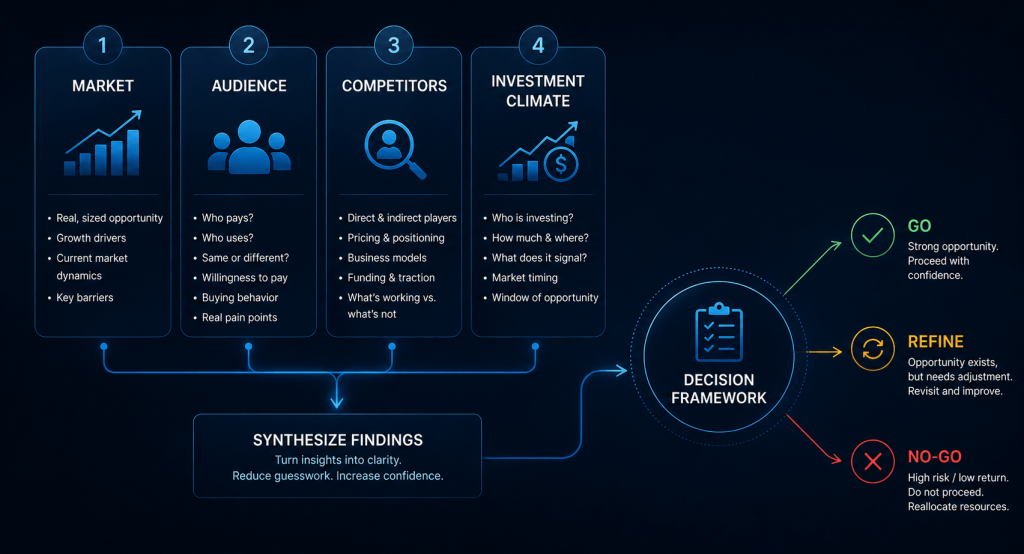
A real feasibility and competitor check — the kind that should happen before a roadmap, not after a disappointing pilot — needs to answer four things, in this order:
1. The market itself — is this a real, sized opportunity, and what's actually driving or blocking growth in it right now, not two years ago.
2. The target audience — who pays, who uses, and whether those are the same people; their real willingness to pay, not their polite enthusiasm in a discovery call.
3. Competitors and business models — direct and indirect players, what they charge, what they've raised, and which business models are actually working versus merely common.
4. Investment and timing — who else is funding this space, what that signals about the window you're building in, and whether you're early, on time, or late.
Skipping any one of these doesn't make the product safer to build faster. It just moves the failure later, where it costs more and looks like a technology problem instead of a research one.
The two-week check versus the year you don't get back
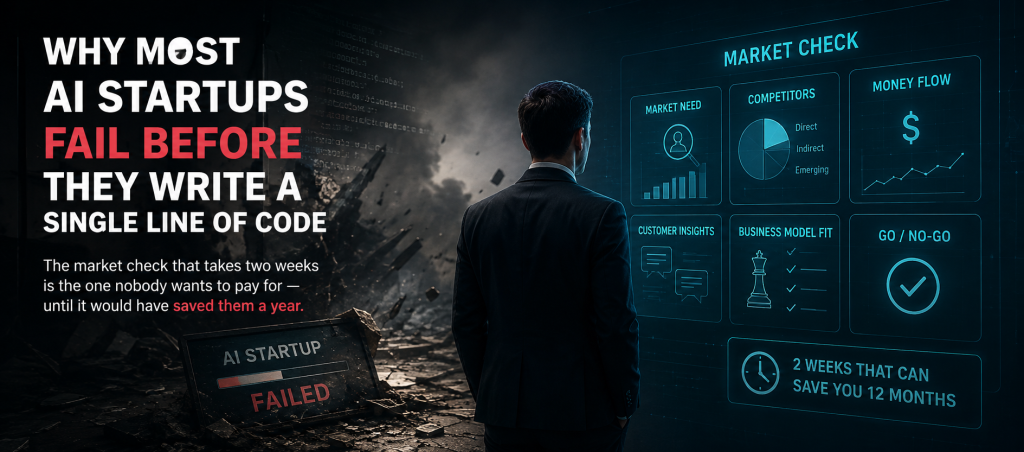
None of this requires a six-month study. A tight, well-run market and competitor review — scoped correctly — typically takes one to a few weeks, not months, and it answers the specific question that matters: is this worth building, and if so, what should it actually look like. Compare that against the alternative: a build that quietly absorbs a year of runway before the market tells you, the hard way, what a proper review would have told you on week two.
This isn't an argument against moving fast in AI. It's an argument for spending two weeks confirming the destination before spending a year driving toward it.
Where this fits in your next AI decision
If you're weighing a new AI product, feature, or internal initiative, the question worth answering first isn't "can we build it" — it's "does this pay back, and for whom." That's exactly what CLEAR Discovery is built to answer: a structured map of where AI actually creates value in your business or market, backed by real competitor and audience research, ending in a signed, ranked recommendation you can act on — with or without us.